

GOLD
Gold, as an element, is a dense, shiny, deep yellow precious metal. It has several qualities that have made it valuable throughout history, both as a medium of exchange and for decorative use in jewelry. It is attractive in color and brightness; it is so durable it's practically indestructible. Gold is also rare and usually found in nature in a relatively pure form. Gold is the most malleable and ductile of metals. It may be beaten into gold leaf as thin as 4 millionths of an inch - an ounce can be beaten out to 187 square feet. An ounce of gold can also be drawn into a wire more than 40 miles long.
Gold is a good conductor of electricity, though not as good as silver or copper. Gold is the noblest of the "noble metals" - (gold, platinum, palladium and rhodium) so called because of their inertness, or reluctance to enter into chemical reactions. It will not combine directly with oxygen nor will it react with common acids. Gold is, however, attacked by a 3-to-1 mixture of hydrochloric and nitric acids. This reagent is called aqua regia (Latin for royal water) because it reacts with the so-called royal metal.
In jewelry, gold is commonly alloyed with other metals in proportions that yield desired hardnesses and colors. An alloy of gold, silver, and copper, in which the amounts of silver predominates, is called "green gold." An alloy of the same three elements in which copper predominates is called "red gold." An alloy of gold and nickel is called "white gold."
The purity of gold is expressed in karats (kt), on a scale of 24, or in fineness, on a scale of 1,000. Pure gold is 24 karat, or 1,000 fine. An alloy containing 75 percent gold would be described as 18-karat gold or 750 fine.
Since gold is visually pleasing, workable and does not tarnish or corrode, it was one of the first metals to attract human attention. Examples of elaborate gold workmanship, many in nearly perfect condition, survived from ancient Egyptian, Minoan, Assyrian, and Etruscan artisans.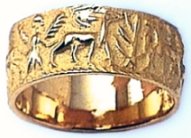 Gold has, also,
continued to be a highly favored material used to craft jewelry and
other decorative objects.
Gold has, also,
continued to be a highly favored material used to craft jewelry and
other decorative objects.
The search for gold has been a major force in history. Men have fought wars and conquered empires to obtain it. Desire for gold motivated the conquests of Alexander the Great and the campaigns of Julius Caesar. The hope of finding gold also inspired the voyages of Christopher Columbus, Vasco da Gama, Ferdinand Magellan, and other explorers. In the Middle Ages, alchemists sought to make gold from the base metals lead and copper. The alchemists failed, but the modern science of chemistry gradually evolved from their work.
Because of its unique qualities, gold has been universally accepted in exchange for goods and services. Gold began to serve as backing for paper-currency systems when they became widespread in the 19th century, and although gold's official role in the international monetary system had come to an end by the 1970s, gold remains a highly regarded reserve asset. In the last 500 years, about 80,000 tons of gold have been taken from the earth. World reserves of gold economically recoverable by present methods may total only about 32,000 tons. Since gold is both durable and carefully guarded, most of the gold that has been taken from the earth still exists. Much of it has been buried again -- in underground vaults, where it is held in government monetary reserves. Approximately 45% of the entire world's gold is held by governments and central banks for this purpose. Gold is still accepted by all nations as a medium of international payment and is widely distributed throughout the world.
Tiny quantities of gold occur in most rocks and soils. Its abundance in the Earth's crust is estimated at about 0.005 parts per million. Usually, however, the amount of gold is so minute that the cost of extracting it would exceed its value. It is dispersed in low concentrations in all igneous rocks. Gold occurs mostly in the native state, remaining chemically uncombined. It often occurs in association with copper and lead deposits, and, though the quantity present is often extremely small, it is readily recovered as a by-product in the refining of those base metals. One-third of all gold is produced as a by-product of copper, lead, and zinc production. Where gold occurs in higher concentrations, the deposits are of two basic types: hydrothermal veins, associated with quartz and pyrite (fool's gold); and placer deposits that are derived from the erosion of gold-bearing rocks and appear in alluvium and stream beds. The origin of enriched veins is not known but theories contend that gold was carried to the surface from great depths in the earth's mantle, in partial solid solution, and later solidified.
In addition to its historic use as currency and jewelry, gold has also been applied in dentistry and medicine. Today, because of its non-corrosive properties it is playing an increasing role in industrial processes. In the late 20th century, South Africa, Russia, the United States, and Australia accounted for two-thirds of the gold produced annually throughout the world. South Africa alone, with its vast Witwatersrand mines, produces about one-third of the world's gold.
Physical Properties of Gold:
Melting point: 1063 degrees K
Symbol: Au
Crystal System: Face-centered cubic
Crystal Hardness: 2.5 - 3.0 Mohs'
Cleavage: None
Fracture: None
Specific Gravity: 19.3
Color: deep yellow
Luster: bright, shiny, metallic
Gold, as an element, is a dense, shiny, deep yellow precious metal. It has several qualities that have made it valuable throughout history, both as a medium of exchange and for decorative use in jewelry. It is attractive in color and brightness; it is so durable it's practically indestructible. Gold is also rare and usually found in nature in a relatively pure form. Gold is the most malleable and ductile of metals. It may be beaten into gold leaf as thin as 4 millionths of an inch - an ounce can be beaten out to 187 square feet. An ounce of gold can also be drawn into a wire more than 40 miles long.
Gold is a good conductor of electricity, though not as good as silver or copper. Gold is the noblest of the "noble metals" - (gold, platinum, palladium and rhodium) so called because of their inertness, or reluctance to enter into chemical reactions. It will not combine directly with oxygen nor will it react with common acids. Gold is, however, attacked by a 3-to-1 mixture of hydrochloric and nitric acids. This reagent is called aqua regia (Latin for royal water) because it reacts with the so-called royal metal.
In jewelry, gold is commonly alloyed with other metals in proportions that yield desired hardnesses and colors. An alloy of gold, silver, and copper, in which the amounts of silver predominates, is called "green gold." An alloy of the same three elements in which copper predominates is called "red gold." An alloy of gold and nickel is called "white gold."
The purity of gold is expressed in karats (kt), on a scale of 24, or in fineness, on a scale of 1,000. Pure gold is 24 karat, or 1,000 fine. An alloy containing 75 percent gold would be described as 18-karat gold or 750 fine.
Since gold is visually pleasing, workable and does not tarnish or corrode, it was one of the first metals to attract human attention. Examples of elaborate gold workmanship, many in nearly perfect condition, survived from ancient Egyptian, Minoan, Assyrian, and Etruscan artisans.
Gold has, also,
continued to be a highly favored material used to craft jewelry and
other decorative objects.
The search for gold has been a major force in history. Men have fought wars and conquered empires to obtain it. Desire for gold motivated the conquests of Alexander the Great and the campaigns of Julius Caesar. The hope of finding gold also inspired the voyages of Christopher Columbus, Vasco da Gama, Ferdinand Magellan, and other explorers. In the Middle Ages, alchemists sought to make gold from the base metals lead and copper. The alchemists failed, but the modern science of chemistry gradually evolved from their work.
Because of its unique qualities, gold has been universally accepted in exchange for goods and services. Gold began to serve as backing for paper-currency systems when they became widespread in the 19th century, and although gold's official role in the international monetary system had come to an end by the 1970s, gold remains a highly regarded reserve asset. In the last 500 years, about 80,000 tons of gold have been taken from the earth. World reserves of gold economically recoverable by present methods may total only about 32,000 tons. Since gold is both durable and carefully guarded, most of the gold that has been taken from the earth still exists. Much of it has been buried again -- in underground vaults, where it is held in government monetary reserves. Approximately 45% of the entire world's gold is held by governments and central banks for this purpose. Gold is still accepted by all nations as a medium of international payment and is widely distributed throughout the world.
Tiny quantities of gold occur in most rocks and soils. Its abundance in the Earth's crust is estimated at about 0.005 parts per million. Usually, however, the amount of gold is so minute that the cost of extracting it would exceed its value. It is dispersed in low concentrations in all igneous rocks. Gold occurs mostly in the native state, remaining chemically uncombined. It often occurs in association with copper and lead deposits, and, though the quantity present is often extremely small, it is readily recovered as a by-product in the refining of those base metals. One-third of all gold is produced as a by-product of copper, lead, and zinc production. Where gold occurs in higher concentrations, the deposits are of two basic types: hydrothermal veins, associated with quartz and pyrite (fool's gold); and placer deposits that are derived from the erosion of gold-bearing rocks and appear in alluvium and stream beds. The origin of enriched veins is not known but theories contend that gold was carried to the surface from great depths in the earth's mantle, in partial solid solution, and later solidified.
In addition to its historic use as currency and jewelry, gold has also been applied in dentistry and medicine. Today, because of its non-corrosive properties it is playing an increasing role in industrial processes. In the late 20th century, South Africa, Russia, the United States, and Australia accounted for two-thirds of the gold produced annually throughout the world. South Africa alone, with its vast Witwatersrand mines, produces about one-third of the world's gold.
Physical Properties of Gold:
Melting point: 1063 degrees K
Symbol: Au
Crystal System: Face-centered cubic
Crystal Hardness: 2.5 - 3.0 Mohs'
Cleavage: None
Fracture: None
Specific Gravity: 19.3
Color: deep yellow
Luster: bright, shiny, metallic
Information
Policies


© Copyright
1995-2026 WeddingBands.com. All rights reserved