

Wedding Bands & Wedding Rings
The history of the wedding and engagement ring has been written across culture and time fashioning an indelible thread in the fabric of western society. When the Romans began to wear a plain iron band to symbolize marriage, they started a tradition that has remained virtually intact over the past two millennia.
As early as the 2nd Century AD, gold replaced iron and the traditional wedding band was constructed. Almost 1300 years afterward the first diamond wedding ring was adopted into ceremony. Coming even later, arriving around 1900, platinum became an alternative metal to the traditional styles that existed. Today, as few of us question our bridal traditions, we leave history to describe how and why we have come to take for granted these universal symbols of love.
In ancient cultures it was believed that
the third finger of the left hand, had a special vein called vena amoris, the
vein of "love," that ran from the "ring finger" finger directly to the heart.
There is, of course, no scientific basis for this romantic theory, but the
custom has endured through generations.
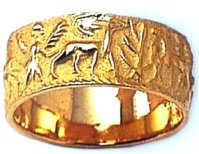 It was King Edward VI of England who decreed that the third finger of the left
hand be designated as the "official" ring finger and, in 1549, the Book of
Common Prayer sealed the deal with the designation of the left hand as the
marriage hand. Despite the designations, in many European countries brides wear
their wedding rings on the right hand.
It was King Edward VI of England who decreed that the third finger of the left
hand be designated as the "official" ring finger and, in 1549, the Book of
Common Prayer sealed the deal with the designation of the left hand as the
marriage hand. Despite the designations, in many European countries brides wear
their wedding rings on the right hand.
The circle has always had significance in ancient cultures as a symbol of wholeness and of perfection. Its endlessness is the perfect symbol of oneness and unity without beginning that has no beginning or end. It is also the symbol of the sun, earth and universe, and represents holiness, perfection and peace. Even our earliest forefather, the caveman, bound himself to his mate with a cord of woven rushes as a symbol that their spirits were one. Ancient Northern European cultures believed that a lover's knot was a symbol of love, faith, and friendship. The woven knot was formed out of the hair of the beloved then worn as a ring. Among the Anglo-Saxons a part of the "wed" was a ring worn on her right hand. As a symbol of the cycle of life and an arresting image for all to see, the wedding band was adopted into the Christian marriage ceremony and has thus survived today.
But, why gold? We have all heard tales of obsession and devastation, simply to possess the lustrous, rare metal whose history continues to fascinate people across cultures. The Egyptians, who produced gold on a massive scale, limited its audience to the pharaohs. After all, who else could be worthy of wearing a symbol of the sun, the Egyptian source of life? Almost all ancient civilizations, at least those with access to gold, began to use gold in the most important aspects and rituals of their culture. The ancient Greeks, aided by their extensive developments in trading developed similar uses of gold as their contemporaries, the Egyptians. Both cultures reserved their greatest artisans to craft gold jewelry and both civilizations left gold adornments with their dead, to be worn in the afterlife. Throughout Asia, gold was implemented into jewelry making and religious ceremonies in similar fashion to its Western counterparts. Africa saw tribal conflicts and the introduction of Westerners all in the name of their gold. Unfortunately, many Central and South American indigenous tribes were eradicated as a result of the European passion for gold. But, why has gold become the staple of modern bridal jewelry? Gold combines the elements of elegance, authenticity, durability and workability.
Experts estimate that approximately
100,000 tons of gold have been extracted from the earth in recorded history.
And, because its mining and extricating are so time-consuming and expensive
(several tons of ore are necessary in order to produce a single ounce of gold)
gold has always been precious. Yet, the skilled artisan and the experienced
metallurgist have, over the centuries, mastered the subtle shades of gold by
combining it with trace amounts of other elements.
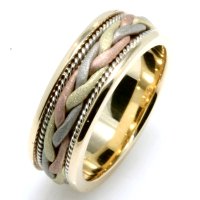 Goldsmiths can create yellow, rose, green and white shades that have allowed gold to
expand its purpose and appeal. In the same vain, gold can been strengthened or
softened, through combination, creating durability or workability. With the
countless design and color possibilities that gold offers, combined with the
history that follows it, it is no wonder why gold became and remains the medium
to display the symbol of unity. Yet, before the 15th century the modern symbol
of conjugal fidelity,
Goldsmiths can create yellow, rose, green and white shades that have allowed gold to
expand its purpose and appeal. In the same vain, gold can been strengthened or
softened, through combination, creating durability or workability. With the
countless design and color possibilities that gold offers, combined with the
history that follows it, it is no wonder why gold became and remains the medium
to display the symbol of unity. Yet, before the 15th century the modern symbol
of conjugal fidelity,
The Diamond, was not introduced in combination with the gold band. It was a mixture of cultures and backgrounds from which today's custom of wedding and engagement rings have evolved. The word "betrothed" comes from the Anglo-Saxon "troweth," meaning truth. Betrothed means giving a truth or pledge and an engagement ring becomes an outward indication to everyone that a woman has pledged her love to one man alone. The Greek "adamant" means steadfast or invincible. It is from this word that the diamond gets its name. Diamonds were believed to be invincible, indestructible, and exceedingly strong.
It is easy to understand then why it was chosen to symbolize purity and light, and protected the wearer against evil. Legend tells us that the diamond's sparkle rose from the lovers' fires, and that it possessed great harmonizing powers. The icy fire of the true white diamond remains the foremost symbol of love. Large-scale diamond mining wasn't introduced until the 19th century, but early man, with his limited contact with diamonds began an affair of intrigue and superstition.
The first diamonds were discovered in India and the inhabitants valued them because they were thought to protect the possessor from illness, thieves, dangerous animals as well as other hazards and evils. The populace of India also used the clarity of diamonds to reflect the casting system, the clearer the stone the more noble the bearer. The Chinese adored the diamond because of its deftness in engraving. In Italy, it was thought to protect its proprietor from the influence of poison.
Historically, the betrothal ring was the only one a bride could expect from her groom. Rings have been used throughout the centuries to mark engagements. Rings with gemstones were popular in the 18th and 19th centuries. The creative gentleman might present his beloved with a gemstone ring where the first letter of the stones within the setting spelled out his name or a word such as, for example, "dearest" (diamond, emerald, amethyst, ruby, epidote, sapphire, turquoise). Medieval wedding rings were often set with colored gemstones, because of the symbolism of the colors. Gentlemen in the Middle Ages often kept a betrothal ring suspended from the band of their hat ready to send to their beloved. During the seventeenth and eighteenth centuries, hearts were a popular motif for engagement and wedding rings. The rings often combined rubies, which symbolized love and diamonds which signified eternity.
Jewish wedding ceremonies, during the
Renaissance period, incorporated very elaborate, intricately-detailed rings.
The bezel of the ring was often made in in the image of a gabled building,
synagogue, or Solomon's Temple. Also in the Renaissance, jewelers created a new
kind of wedding ring called the gimmel, or twin ring. It consisted of two or
more interlocking rings, joined by a pivot, so they could slide together into
one ring . . . symbolizing the union of two lives. The gimmel ring has always
remained popular, in a variety of incarnations. A spinoff of the gimmel ring
was formed so that the hoops terminated in a pair of hands, which clasped
together when the ring was closed. This variation was known as a fede ring
(Italian for faith). It was introduced around 1600 at the very same time that
the Puritans tried--unsuccessfully--to abolish the tradition of the wedding
ring. The fede ring was the forrunner of the poular Irish Claddaugh Ring.
In Persia, it was customary for a bridegroom to give a ring to everyone who attended the wedding ceremony. Queen Victoria and Prince Albert gave out six dozen rings, each engraved with the queen's profile, at their wedding ceremony. Incidentally, Queen Victoria's engagement ring was in the form of a serpent. The snake motif was believed to be a symbol of good luck.
The smallest betrothal ring on record was given to two year old Princess Mary, daughter of Henry VIII. When she became engaged to the infant Dauphin of France, son of King Francis I, in 1518 a tiny gold ring, set with a valuable diamond, was fitted to her finger. Although, the earliest known example of a ring combining diamonds and gold comes from Rome in the third century, it wasn't until 1477 that a diamond/gold ring became the cornerstone in a betrothal ceremony, when Mary of Burgundy received a diamond betrothal ring from Archduke Maximilian of Austria, tradition was reinvented. The diamond was chosen to become part of ritual marriage because of its resistance to fire and steel.
The new wedding ring was to be placed on the fourth finger of the left hand, according to ancient Greek belief, to be in contact with the vein of love that ran from that finger directly to the heart. Diamonds eventually replaced colored stones as the symbol of betrothal.
Why did the diamond remain when the rest were discarded? The rarity and durability of diamonds is often documented and universally known. Each diamond, as distinctly unique as its owner, takes over 250 tons of ore to be blasted, crushed and processed to yield one carat of rough diamond. Of these, approximately one of five is suitable to be cut. Its beauty and wonder, never questioned, leave little doubt as to why the diamond has remained today in the marriage ceremony. Still, it would take centuries of exploration and excavation to allow tradition to become substantive to the average person.
Techniques in diamond cutting and new technologies afforded the medieval jeweler opportunity to experiment with different styles and cuts of the gold/diamond wedding ring. And, as society's tastes changed, so did the wedding ring. Christian dictates reinvented the reason for wearing the ring on the fourth finger, the priest touching the three fingers of the left hand, The Father, The Son and The Holy Ghost, ending with the fourth finger. But, the diamond wedding ring was only available to the most elite until the mid 19th century and the mining of Africa. This event offered the popularization of the diamond engagement ring. Before the discovery and excavation of the African diamond mines, a woman could only expect a diamond on her wedding day.
The increasing demand for diamonds, met
with mass importation, created the tradition of the engagement ring.
Technologies continued to offer better ways of mining and diamond cutting, as
well as improvements in ways to use gold, but the last step in molding modern
tradition was the introduction of platinum.
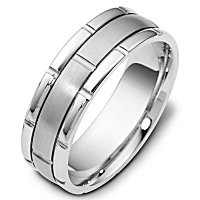 Around 1900 platinum was universally adopted because of its untarnishable whiteness,
strength and durability. The jeweler could afford to use a far smaller setting
and display the stone more prominently.
Around 1900 platinum was universally adopted because of its untarnishable whiteness,
strength and durability. The jeweler could afford to use a far smaller setting
and display the stone more prominently.
Platinum was used in Ancient Egypt; it was mined by the Incas, and introduced into Europe around 1780. Cartier and Faberge loved platinum and even the Hope diamond is set in it. Tiffany, the famous New York jeweler, invented revolutionary designs in platinum settings that exposed the stones from a variety of facets, making the mounting a test for the ring's quality.
Platinum is renowned for its purity, containing anywhere from 85 to 95% pure platinum. 18kt gold contains only 75% pure gold. If a piece of jewelry is branded "platinum" then it contains at least 95% pure platinum. Jewelry marked 950 Plat contains and 95% platinum. Other grades are arranged accordingly. Platinum is quite popular today because of its rarity and durability. There are only a handful of platinum mines worldwide and it takes 10 tons of ore to produce one ounce of platinum compared to three tons of ore to produce an ounce of gold. Platinum retains its white luster long after it has been crafted and its recent revival after a short period of negligence has restated custom.
World War II temporarily took platinum off the market and made it unavailable to jewelers for use in engagement rings and wedding bands. Consequently, during the war years, most such rings made were of gold. Also during World War the double-ring wedding ceremony, an old European custom, in which the groom and the bride receive a wedding band, saw a resurgence. Its popularity continues today.
Recently, palladium, a noble metal closely resembling platinum but much more affordable has been gaining attention and is becoming popular. Today couples not only adorn a wedding band whose symbol remains constant since its inception almost two thousand years ago, but advances in metallurgy and stone cutting make the tradition of buying an engagement ring or even the more modern anniversary band, and exciting prospect.
Whether you wear a white gold wedding band or a diamond platinum engagement ring, the symbol you model represents more then emblem of your love; it marks the evolution of culture and desire into a time-honored tradition. Today's engaged couple faces both traditional and more contemporary choices. The range is anywhere from the tradition diamond in a traditional setting to a glittering range colored gems, or a mixture of the gemstones and diamonds.
The bride should be aware that no stone is as durable and strong as a diamond and that gemstones, although lovely, are more delicate. The bride might also choose to wear only one, perhaps unusually ornate, wedding band. Another recent trend has the bride offering her fiancé his own engagement ring, perhaps a solitaire that will be paired with a complementary wedding band, or adding a diamond to his wedding band. Settings too have also changed recently. The classic raised prong setting of the diamond engagement ring will always be a standard and maintain its popularity, But the bezel setting is also becoming popular. A bezel-set stone is completely encircled by a collar of metal. An even more contemporary setting is the "tension setting." In this setting there are no prongs at all and the diamond is held in place by the tension of the ring itself. Tension settings are usually set in platinum, because the strength of this metal is required to hold the stone securely.
What surely is true is that the wedding and engagement ring are symbols of one's love for the other, so their purchase ought to one that is given due attention and consideration. Tradition, personal preferences, and budget will all be taken into careful consideration.
Information
Policies


© Copyright
1995-2026 WeddingBands.com. All rights reserved