

Diamonds ascend to the Earth's surface in rare molten rock, or magma that originates at great depths. Carrying diamonds and other samples from Earth's mantle, this magma rises and erupts in small but violent volcanoes. Just beneath such volcanoes is a carrot-shaped "pipe" filled with volcanic rock, mantle fragments, and some embedded diamonds. The rock is called kimberlite after the city of Kimberley, South Africa, where the pipes were first discovered in the 1870s. Another rock that provides diamonds is lamproite. The complex volcanic magmas that solidify into kimberlite and lamproite are not the source of diamonds, only the elevators that bring them with other minerals and mantle rocks to Earth's surface. Although rising from much greater depths than other magmas, these pipes and volcanic cones are rare and relatively small, but they erupt in extraordinary supersonic explosions. Kimberlite and lamproite are similar mixtures of rock material. Kimberlite magma rises through Earth's crust in networks of cracks or dikes. The pipes only form near the earth's surface. This cross-section of a kimberlite pipe shows the carrot-shaped profile produced by explosive eruption. The root zone starts in fissures, where gases are released from the rising magma and drive the eruption; they blow out the fragment-laden kimberlite to form the volcano's tuff ring and fill the pipe. Depth measurements show the level of erosion for various kimberlite pipes in South Africa.
Today diamonds are mined in about 25 countries, on every continent but Europe and Antarctica. However, only a few diamond deposits were known until the 20th century, when scientific understanding and technology extended diamond exploration and mining around the globe. For 1,000 years, starting in roughly the 4th century BCE, India was the only source of diamonds. In 1725, important sources were discovered in Brazil, and in the 1870s major finds in South Africa marked a dramatic increase in the diamond supply. Additional major producers now include several African countries, Siberian Russia, and Australia. It is a modern misconception that the world's diamonds come primarily from South Africa: diamonds are a world-wide resource. The 1867 discovery of diamonds in the Cape Colony, now a province in South Africa, radically modified not only the world's supply of diamonds but also its conception of them. As annual world diamond production increased more than tenfold in the following 10 years, a once extremely rare material became more accessible to Western society with its growing wealth, science learned that diamonds came from volcanoes, and everyone learned of Cecil John Rhodes, Barney Barnato, Kimberley, and De Beers. Today South Africa maintains its position as a major diamond producer.
The story of diamonds in South Africa begins between December 1866 and February 1867, when 15-year-old Erasmus Jacobs found a transparent stone on his father's farm, on the south bank of the Orange River. Over the next 15 years, South Africa yielded more diamonds than India had in over 2,000 years. This great outpouring of diamonds coincided with depletion of Brazilian deposits and with a great rise in wealth, particularly in the United States. Geologic processes create two basic types of diamond deposits, referred to as primary and secondary sources. This diagram shows the trail of diamonds left by geological processes. The primary deposits, or diamond pipes, are the vertical portion. Secondary or alluvial deposits may be found far from active means of transport, in the fossilized channels of now-vanished rivers or under fossil beaches.
Composition and Properties
Diamond is renowned for its hardness. Hardness is the measure of a substance's resistance to being scratched, and only a diamond can scratch another diamond. Diamond is the hardest substance known. The Mohs scale, a hardness scale developed in 1822 by Austrian Friedreich Mohs as a criterion for mineral identification, can help us appreciate the hardness of diamond. The scale ranks 10 minerals; harder minerals, with a higher number, can scratch those with a lower number. A diamond rates a 10 on this scale, the hardest of any mineral tested.
Diamonds repel water, an unusual property for a mineral. Diamond's strong bonding and carbon composition cause its surface to repel water but to readily accept wax and grease. These two properties provide an effective means of separating diamonds from other minerals that come out of mining operations. Washed gravel containing diamonds is flushed with water over a sloping surface covered with a mixture of wax and grease, a "grease table." The diamonds stick to the table, while the wetted waste minerals wash over it. Gem diamonds readily pick up a greasy film, but cleaning with ammonia or a good detergent restores their brilliance.
Density is a ratio of a substance's mass to its volume. For instance, density explains why a certain amount of lead feels heavier than an equal volume of salt. Diamond is amazingly dense given the low atomic weight of carbon. At 3.51 grams per cubic centimeter, diamond is much denser than graphite, which weighs in at only 2.20 grams per cubic centimeter. This comparison offers an important clue to diamond's origin: the fact that diamond's carbon atoms are "squeezed" together tighter than in graphite, which forms near Earth's surface, implies that diamond is formed under high pressure conditions. This magnitude of pressure is difficult to comprehend. An example of the enormous amount of pressure required to make a diamond would be the Eiffel Twoer (7000 metric tons) resting on a 5 inch plate. It is 55,000 atmospheres necessary to make a diamond at 1400 degrees C (orange hot).
Diamond's brilliance and luster are two of its most valued attributes. The science behind such phenomena is diamond's great ability to refract light; that is, to bend or slow the light that passes through it. Diamond also displays the maxim amount of reflectance for a transparent substance, displaying what is called an "adamantine" luster. Our standard conception of diamond is as a colorless stone. However, colors of diamonds come in countless variations, from dazzling pinks and yellows to stunning blues and violets. While perfect crystals of colorless diamonds are chemicallly pure, with the presence of nitrogen, the diamond will be yellow. With the presence of boron, a diamond will be blue. Colors from red to violet, real white, and black are possible and can be complex to understand scientifically. The glinting spectrum or "fire" from a colorless diamond, one of its most prized attributes as a gemstone. This property results from its excellent dispersion. Dispersion is the separation of white light into its component rainbow colors. The greater the dispersion, the greater the separation between the spectrum of colors that are refracted from a gem, a characteristic described as a gem's "brilliance." An interesting property of some diamonds is that they can glow in the dark. When illuminated by ultraviolet light, certain diamonds can absorb the high-energy radiation and re-emit it as visible light. These diamonds are called fluorescent. Diamonds that continue glowing after the ultraviolet source is turned off are called phosphorescent. Diamonds are called "ice" with good reason. Objects feel cold not only because they are at a lower temperature than our bodies, but also because they can extract or conduct the heat away from us. When you touch a diamond to your lips, it feels ice-cold because it robs your lips of their heat. The capacity of diamond to conduct heat distinguishes it readily from other gems and exceeds that of copper, an excellent thermal conductor, by about 4 times.
History
The word diamond derives from the Greek word "Adamas," meaning unconquerable and indestructible. Diamonds have been sought the world over, fought over, worshipped and used to cast love spells.
For the last 3000 to 4000 years, diamonds have held special magic for Kings, Queens and their subjects. Diamonds stood for wealth, power, love, spirit and magical powers. Kings in ancient times would wear heavy leather breast plates studded with diamonds and other precious stones into battle. It was believed that diamonds were fragments of stars and the teardrops of the Gods. The diamonds possessed magical qualities of the Gods and held powers far beyond the understanding of the common man. Because of these beliefs, the warriors stayed clear of the Kings and others who were fortunate to have the magical diamonds in their breast plates. Until the 15thCentury only Kings wore diamonds as a symbol of strength, courage and invincibility.
Over the centuries, the diamond acquired its unique status as the ultimate gift of love. It was said that cupids' arrows were tipped with diamonds that had a magic that nothing else could equal. Since the discovery of diamonds they have been associated with romance and legend. The Greeks believed the fire in the diamond reflected the constant flame of love. For millions of people around the world, the mystery and magic, along with the beauty and romance shining out from a simple solitaire says all the heart feels but words can not express.
The first river-bed (alluvial) diamonds were probably discovered in India, in around 800 B.C. The volcanic source of these diamonds was never discovered, but the alluvial deposits were rich enough to supply most of the world's diamonds until the eighteenth century. It was then that dwindling Indian supplies probably spurred the exploration that led to the discovery of diamonds in Brazil, which became the next important diamond source. Beginning in l866, South Africa's massive diamond deposits were discovered, and a world-wide diamond rush was on. Throughout much of history, diamonds were mined from the sand and gravel surrounding rivers. But in South Africa in 1870 diamond was found in the earth far from a river source, and the practice of dry-digging for diamonds was born. More sophisticated mining techniques allowed for deeper subterranean digging, as well as more efficient river (and, more recently, marine) mining, than ever before. The South African diamond output was unrivaled until major deposits were found in Siberian permafrost in l954. Currently, Western Canada is the site of the world's newest diamond rush.
Diamonds were once believed to hold many magical, mystical and medicinal properties. The phosphorescence of certain diamonds (their ability to glow in the dark) was considered a proof of the stone's extraordinary powers. Diamonds were thought to calm the mentally ill, and to ward off devils, phantoms and even nightmares. They were supposed to impart virtue, generosity and courage in battle, and to cause lawsuits to be determined in the wearer's favor.
A house or garden touched at each corner with a diamond was supposed to be protected from lightning, storms and blight. The ancient Indians believed the human soul could pass through various incarnations, animating gemstones as well as plants and animals.
Plato, the Greek philosopher, shared the belief that gems were living beings, produced by a chemical reaction to vivifying astral spirits. Later philosophers divided precious stones into male and female specimens, and even claimed that they could "marry" and reproduce! Minerals were among the first medicinal ingredients. In the middle ages it was believed that a diamond could heal if the sick person took it bed and warmed it with his body, of breathed upon it while fasting or wore it next to the skin. A diamond held in the mouth would correct the bad habits of liars and scolds. And diamonds were worn as a talisman against poisoning.
Diamond powder administered internally, however, was a legendary poison. The Turkish Sultan Bajazet (1447 - 1513) was perhaps murdered by his son, who slipped a large quantity of powdered diamond in his father's food. In l532, his doctors dosed Pope Clement VII with fourteen spoonfuls of pulverized gems, including diamond, which resulted in death for the patient, as well as a very high bill for his treatment. In the same century, Catherine de Medici was famous for dealing out death by diamond powder, and Benvenuto Cellini, the famous s Italian goldsmith, described an attempt on his life by an enemy who ordered diamond powder to be mixed in his salad. But the lapidary responsible for grinding the diamond filched the stone, replacing it with powdered glass (thereby saving Cellini).
The association of diamonds with poison may have been promoted to discourage the practice of stealing diamonds by swallowing them, particularly during mining.
POINT CUT TABLE CUT ROSE CUT OLD MINE BRILLIANT CUTTING The cutting of diamonds into the complex faceted forms we now associate with these gems is actually a relatively recent practice. For centuries, rough diamonds were kept as talismans, and often not worn at all, though natural octahedral (eight-sided stones) were sometimes set in rings. A Hungarian queen's crown set with uncut diamonds, dating from approximately l074, is perhaps the earliest example of diamond jewelry. We know that the royalty of France and England wore diamonds by the 1300's. In sixteenth century England, fashionable lovers etched romantic pledges on window-panes with the points of their diamond rings, known as "scribbling rings". The earliest record of diamond-polishing (with diamond powder) is Indian, and dates from the fourteenth century. There are also contemporary references to the practice of diamond polishing in Venice. The earliest reference to diamond cutting is in l550 in Antwerp, the most important diamond center of the period, where a diamond-cutters' guild was soon to be established.
Diamond Routes and Centers
Indian diamonds reached Venice by two Mediterranean routes: the southern route was by way of Aden, Ethiopia, and Egypt, and the northern route was through Arabia, Persia, Armenia, and Turkey. Then, thanks to the Portuguese discovery of the direct sea route to India, Antwerp flourished as a diamond center, as the city was well-situated to receive vast supplies of rough diamonds from Lisbon as well as from Venice. After Spanish attacks on Antwerp in1585, many diamond cutters relocated to Amsterdam. The Netherlands, with its liberal civil policies, attracted diamond craftsmen (including many Jews) who were fleeing religious persecution in Spain, Portugal, Germany and Poland. In the late1600's, as the English fortified their interest in India, which was still the world's central diamond source, London became an important cutting center. Later, London became the primary world market of diamond rough. Today, there are cutting centers all over the world, most notably in Belgium, India, Israel, South Africa, and the USA.
Famous Diamonds
Famous diamonds often have complex and even controversial histories because of the secrecy that surrounds the stones.
The Cullinan I or Star of Africa diamond, at 530.20 carats, is the largest cut diamond in the world. Pear-shaped, with 74 facets, it is set in the Royal Scepter (kept with the other Crown Jewels in the Tower of London). It was cut from the 3,106-carat Cullinan, the largest diamond crystal ever found. The Cullian was discovered in Transvaal, South Africa in l095 on an inspection tour of the Premier Mine. The Cullian was cut by Joseph Asscher and Company of Amsterdam, who examined the enormous crystal for around six months before determining how to divide it. It eventually yielded nine major, and 96 smaller brilliant cut stones. When the Cullian was first discovered, certain signs suggested that it may have been part of a much larger crystal. But no discovery of the "missing half" has ever been authenticated.
The Excelsior, the second largest stone was found in l893 by a South African mine worker who picked it out of a shovelful of gravel. This high-clarity, blue-white stone was cut into 21 polished stones, because of its irregular shape, of which the largest was a marquise of 69.80 carats. A smaller, 18-carat marquise stone cut from the Excelsior was displayed at the l939 World's Fair by De Beers.
The Great Mogul, the world's third largest gem-quality diamond was named after Shah Jehan who built the Taj Mahal. It was found in the mid-seventeenth century in Hyderabad, India. Its whereabouts are not presently known, and it may no longer exist as a single large stone. It has been confused with several other famous diamonds, most importantly the Orloff, which has also been described as a faintly blue rose-cut stone. It is said that the stone was so badly cut that the lapidary, instead of being paid by the Shah, was forced to pay a heavy fine. When Tavernier saw the Mogul, he described it as looking like an egg, and weighing 280 old carats.
The Darya-i-Nur is a flawless, transparent pink stone, estimated at 175 to 195 carats. It is the largest and most remarkable gem in the Crown Jewels of Iran, and was one of the spoils of Persia's attack on Delhi in l739. It is now set in a gold frame with other diamonds, topped by a crown bearing lions with ruby eyes, holding scimitars. It was worn by the last Shah for his coronation in l967.
The Koh-i-Nur diamond means "Mountain of Light", its history, dating back to1304, is the longest of all famous diamonds. It was captured by the Rajahs of Malwa in the sixteenth century by the Mogul, Sultan Babur and remained in the possession of later Mogul emperors. It may have been set in the famous Peacock Throne made for Shah Jehan. After the break-up of the Persian Empire the diamond found its way to India. It may have traveled to Afghanistan with a bodyguard of Nadir Shah, who fled with the stone when the Shah was murdered, to be later offered to Ranjit Singh of the Punjab in exchange for military help (which was never delivered). After fighting broke out between the Sikhs and the British, The East India Company claimed the diamond as a partial indemnity, and then presented it to Queen Victoria in 1850. When the stone came from India, it weighed l86 carats; it was later recut to l08.93 carats. It was first worn by the Queen in a brooch. It was later set in the State Crown, worn by Queen Alexandra and Queen Mary, and 1937 was worn for by Queen Elizabeth for her coronation. It is kept in the Tower of London, with the other Crown Jewels.
The Hope Diamond's history began when the French merchant traveler, Jean Baptiste Tavernier, purchased a 112 3/16-carat diamond. This diamond, which was most likely from the Kollur mine in Golconda, India, was somewhat triangular in shape and crudely cut. Its color was described by Tavernier as a "beautiful violet". Tavernier sold the diamond to King Louis XIV of France in 1668. In 1673 the stone was recut by Sieur Pitau, the court jeweler, resulting in a 67 1/8-carat stone. In the royal inventories, its color was described as an intense steely-blue and the stone became known as the "Blue Diamond of the Crown," or the "French Blue." It was set in gold and suspended on a neck ribbon that the king wore on ceremonial occasions. King Louis XV, in 1749, had the stone reset by court jeweler Andre Jacquemin, in a piece of ceremonial jewelry for the Order of the Golden Fleece (Toison D'Or). In 1791, after an attempt by Louis XVI and Marie Antoinette to flee France, the jewels of the French Royal Treasury were turned over to the new government. During a week-long looting of the crown jewels in September of 1792, the French Blue diamond was stolen. In 1812 a deep blue diamond described by John Francillion as weighing 177 grains (4 grains = 1 carat) was documented as being in the possession of London diamond merchant, Daniel Eliason. Strong evidence indicates that the stone was acquired by King George IV of England. At his death, in 1830, the king's debts were so enormous that the blue diamond was likely sold through private channels. The first reference to the diamond's next owner is found in the 1839 entry of the gem collection catalog of the well-known Henry Philip Hope, the man from whom the diamond takes its name. Unfortunately, the catalog does not reveal where or from whom Hope acquired the diamond or how much he paid for it. Following the death of Henry Philip Hope in 1839, and after much litigation, the diamond passed to his nephew Henry Thomas Hope and ultimately to the nephew's grandson Lord Francis Hope. In 1902 Lord Francis Hope obtained permission from the Court of Chancery and his sisters to sell the stone to help pay off his debts. It was sold to a London dealer who quickly sold it to Joseph Frankels and Sons of New York City, who retained the stone in New York until they, in turn, needed cash. The diamond was next sold to Selim Habib who put it up for auction in Paris in 1909. It did not sell at the auction but was sold soon after to C.H. Rosenau and then resold to Pierre Cartier that same year. In 1910 the Hope diamond was shown to Mrs. Evalyn Walsh McLean, of Washington D.C., at Cartier's while on her honeymoon in Paris, but she did not like the setting. Cartier had the diamond reset and took it to the U.S. where he left it with Mrs. McLean for a weekend. This strategy was successful. The sale was made in 1912 with the diamond mounted as a headpiece on a three-tiered circlet of large white diamonds. Sometime later it became the pendant on a diamond necklace as we know it today. Harry Winston Inc. of New York City purchased Mrs. McLean's entire jewelry collection, including the Hope diamond, from her estate in 1949. For the next 10 years the Hope diamond was shown at many exhibits and charitable events world wide by Harry Winston Inc., including as the central attraction of their Court of Jewels exhibition. On November 10, 1958, they donated the Hope diamond to the Smithsonian Institution, and almost immediately the great blue stone became its premier attraction. The weight of the Hope diamond for many years was reported to be 44.5 carats. In 1974 it was removed from its setting and found actually to weigh 45.52 carats. The Hope diamond phosphoresces a strong red color, which will last for several seconds after exposure to short wave ultra-violet light. The diamond's blue coloration is attributed to trace amounts of boron in the stone. In the pendant surrounding the Hope diamond are 16 white diamonds, both pear-shapes and cushion cuts. A bail is soldered to the pendant where Mrs. McLean would often attach other diamonds including the McLean diamond and the Star of the East. The necklace chain contains 45 white diamonds. In December of 1988, a team from the Gemological Institute of America visited the Smithsonian to grade the great blue stone according to present day techniques. They observed that the gem shows evidence of wear, has remarkably strong phosphorescence, and that its clarity is slightly affected by a whitish graining that is common to blue diamonds. They described the color as a fancy dark grayish-blue and clarity as VS1. An examination on the same day by another gemologist using a very sensitive colorimeter revealed that there is a very slight violet component to the deep blue color, imperceptible to the naked eye. Still, one can only wonder that the original 112 3/16-carat stone bought by Tavernier was described as "un beau violet" (a beautiful violet).
The 4 C'S of Diamond Grading
The factors that determine the value of a diamond are: color, clarity, cut and carat weight.
Color: The most sought-after diamonds are completely colorless in natural light, with absolutely no undertones of any color. The most colorless diamonds are D grade, with the range of increased color going on through the alphabet to Z. Diamonds with body color greater than Z are termed Fancy Color. In addition to white, diamonds occur in every color of the rainbow. The biggest price jumps here are near the top of the scale, with a rather significant jump between F and G, since F is categorized by the GIA as "Colorless" and the luxury of being able to officially say you own/wear a colorless diamond commands a price. However, it is difficult to see the difference in color between an F and a G stone without removing the stones from their settings and holding it up to reference stones. Most people begin to notice color around H and I, with near 100% recognition at color J. Fluorescence occurs in about 35% of gem-quality diamonds, and is most frequently blue. In very white stones, fluorescence can actually make the diamond appear milky or cloudy and detract from the beauty of the stone; on the other hand, fluorescence may also make a more yellow diamond appear whiter. The type of metal used for the setting of the diamond may have an effect on the color in that differently colored metals will treat the diamond differently. If you bought a very white stone and wished to showcase that color, platinum is an excellent choice, or white gold. Yellow gold is kinder to a stone's color and gives it the illusion of being whiter. There are enhancement techniques used to whiten or color diamond, such as irradiation and high pressure/high temperature treatment.
Clarity: Since diamonds are naturally created in nature all diamonds have inclusions and blemishes. Diamonds are rated for clarity by their appearance under a 10X (10 times) magnification. This finds flaws that cannot be seen by the naked eye but for grading purposes if it cannot be seen at 10X it doesn't exist. Inclusions are internal flaws while blemishes are external flaws. The grading scale goes from FL (Flawless, for diamond with no visible inclusions or blemishes) through VVS 1&2, VS 1& 2, SI 1&2, to I 1, 2&3 (Imperfect, with very noticeable flaws). All the types of inclusions and blemishes and their plotting symbols are given in the chart below: Inclusions are irregularities within the stone itself, and can actually render the stone less durable if they are in the wrong place. Feathers, for example, are tiny fractures in diamond which look, surprisingly enough, like feathers. A good diamond cutter will make sure these feathers, if they must be there at all, are completely inside the stone. If the feather breaks the surface of the diamond, the diamond's durability may be questionable. An enhancement to the clarity of the stone can be completed using a method called lasering, in which a laser is used to remove an unsightly inclusion. On the surface, there will be a tiny hole and a tunnel that will look like a needle. Fracture filling is enhancement in which a glass like substance is use to fill a fracture breaking the surface of a diamond, it makes the fracture less noticeable and in some cases invisible. Laser holes may also be filled. Blemishes are less serious, and are usually caused by human error in cutting the diamond. A stone might also have extra facets which were intentionally cut to remove some inclusion from the stone. Other blemishes are polish lines and marks, which occur during polishing. The marks may sometimes appear like clouding on the surface of the diamond. The girdle might appear pitted or grainy as a result of poor workmanship.
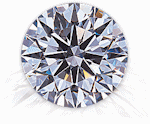
CUT: Cut, as used in grading is not the shape (Round, Marquise etc.) but rather the symmetry, proportion, and make of the stone. The table is the flat surface at the very top of the diamond. The crown is the mass of facets between the table and the girdle. The girdle is the skinny band around the widest part of the diamond. When the girdle is faceted, its facets are not counted in the stone's total facet count. The pavilion stretches from the girdle all the way to the very bottom point, called the culet. A Round Brilliant cut diamond will have the table, 8 star, 8 bezel, and 16 upper girdle facets on the crown. The pavilion should contain 16 lower girdle, 8 pavilion facets and the culet. A well cut diamond takes light from all around and shoots it straight up out of the crown and table, creating brilliance (total light reflected), dispersion (the tendency of the diamond to create rainbows), and scintillation (how much it sparkles when moved). Pear, marquis, and oval shaped diamonds are graded also on the presence of the undesirable bowtie effect. These shapes have a tendency to show an unattractive dark spot in the shape of a bowtie across the center of the diamond; this reduces the stone's value. The grades assigned to cut run from excellent, very good, good, fair to poor. Diamonds come in many shapes. In addition to Round, Marquise, Oval, Princess, Pear etc. it seems every year a new shape or cut is being developed.
Carat weight: 1 carat = 200 milligrams. 100 points = 1 carat. The carat weight is simply that - the stone's weight. Much like the color, there tend to be large price breaks around the various categories diamond dealers use to categorize their diamonds.
Information
Policies


© Copyright
1995-2026 WeddingBands.com. All rights reserved